

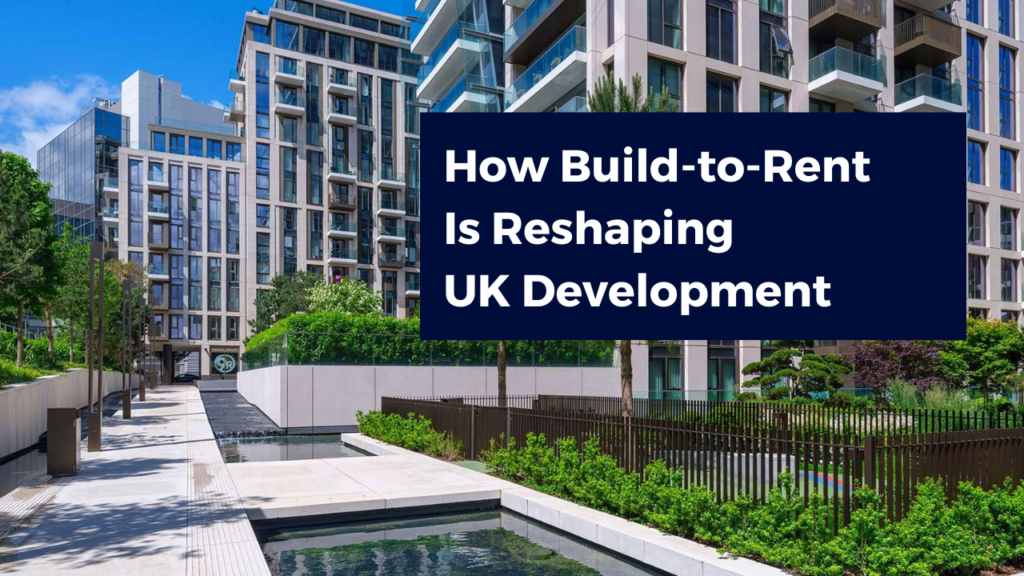
For much of the past decade, Build-to-Rent (BTR) has been viewed as a specialist sector dominated by pension funds, real estate investment trusts and large institutional developers.
In 2026, that distinction is becoming increasingly blurred.
The operational principles that have made Build-to-Rent successful are beginning to influence residential development across the entire market, including schemes intended for private sale. Developers are increasingly recognising that designing solely around the initial transaction is no longer enough. Long-term occupier experience, operational efficiency and asset performance are becoming just as important as construction cost and sales values.
This shift is changing how residential schemes are designed, specified and delivered, regardless of whether they are ultimately retained or sold.
Occupier Expectations Have Changed
Today’s purchasers and tenants compare new developments against professionally managed rental communities rather than simply against neighbouring apartment blocks.
Reliable management, attractive communal spaces, secure parcel handling, high-speed connectivity and responsive maintenance are increasingly viewed as standard expectations rather than premium extras.
Developments that fail to meet these expectations may still achieve sales, but maintaining long-term values and resident satisfaction becomes more challenging.
Forward-thinking developers are therefore considering how a building will operate over the next twenty years, rather than concentrating exclusively on practical completion.
Operational Costs Deserve More Attention During Design
Many costs associated with residential developments are effectively locked in long before construction begins.
Heating systems, ventilation strategies, façade maintenance, lift specifications, refuse storage and access arrangements all influence future service charges and operational efficiency.
Poor design decisions can create unnecessary management costs for decades, affecting both leaseholders and managing agents.
Developers who engage operational specialists during the design stage often identify opportunities to simplify maintenance, reduce lifecycle costs and improve resident experience without significantly increasing capital expenditure.
The result is frequently a building that performs more effectively throughout its lifespan.
Amenity Space is Becoming Increasingly Strategic
Communal facilities were once considered a useful marketing feature.
Increasingly, they influence purchaser behaviour, rental demand and long-term asset performance.
Residents now place greater value on flexible workspaces, landscaped outdoor areas, secure cycle storage, fitness facilities and well-designed communal lounges than they did only a few years ago.
The growth of hybrid working has accelerated this trend.
Developments that successfully support modern lifestyles often enjoy stronger resident retention and improved reputations within local markets.
Importantly, successful amenity provision is rarely about providing the greatest number of facilities. It is about delivering spaces that residents genuinely use.
Quality of Management Affects the Value of the Building
Once a development completes, management quality becomes one of the most influential factors affecting its reputation.
Well-maintained communal areas, efficient communication, proactive maintenance and sensible service charge management all contribute towards purchaser confidence and future resale values.
Developers who establish robust management arrangements from the outset often protect the long-term perception of their schemes far more effectively than those who focus exclusively on the construction phase.
Increasingly, successful residential developments are being viewed as long-term operational businesses rather than completed construction projects.
Sustainability is Becoming a Commercial Issue
Environmental performance is no longer driven solely by regulation.
Purchasers are paying closer attention to running costs, energy efficiency and future resilience against rising utility prices.
Efficient heating systems, improved insulation, renewable technologies and durable construction materials all contribute towards lower operating costs for residents.
In many cases, these features also improve the long-term attractiveness of developments to institutional purchasers, lenders and professional management companies.
As operational costs continue to influence buying decisions, sustainability increasingly supports commercial performance rather than simply satisfying planning policy.
Technology is Changing Resident Expectations
Digital management platforms are becoming increasingly common across new residential developments.
Online reporting systems, digital concierge services, smart access control, parcel management technology and integrated communication platforms all contribute towards a more seamless resident experience.
Although not every development requires advanced technology, buyers increasingly expect basic digital functionality as standard.
Developers who consider operational technology during the design process often avoid expensive retrofitting after occupation.
Designing for Flexibility Protects Future Value
Residential markets rarely remain static.
Changes in demographics, rental demand, employment patterns and regulation continually reshape housing requirements.
Developments capable of adapting to changing market conditions generally retain stronger long-term appeal.
Flexible internal layouts, adaptable commercial space, future-proof building services and robust digital infrastructure all improve a building’s ability to respond to future demand.
This flexibility is becoming an increasingly valuable commercial consideration during the planning and design stages.
Residential Development is Becoming an Operational Business
The distinction between developers, operators and asset managers continues to narrow.
Many of the principles that have driven the success of Build-to-Rent, including customer experience, operational efficiency, lifecycle thinking and proactive management, are proving equally valuable within traditional build-for-sale developments.
The most successful developers are increasingly recognising that completion is not the end of a building’s story.
Rather, it marks the beginning of decades of occupation, management and community building.
Those who design with this broader perspective are often creating developments that remain desirable, commercially resilient and operationally efficient long after the final apartment has been sold.
As the residential market continues to mature, long-term performance is becoming just as important as initial sales performance. Developers who embrace that mindset are likely to be better positioned for the next phase of the UK’s housing market.